




Ready to Embark on an Exciting Journey with WIN?
Take the first step toward personal and financial freedom by filling out the interest form. One of our franchise advocates will be in touch with you soon!



Entrepreneurial innovation transforms ordinary ideas into valuable market solutions that drive business success. It involves identifying unmet needs or inefficiencies in the market and developing new products, services, processes, or business models that solve customer problems and create value.
Smart entrepreneurs know how to anticipate customer problems and develop solutions before those needs become obvious. Adaptability is essential to an entrepreneurial mindset, especially as rapid technological advancements, such as the growing use of AI in business, and increasing competition continue to reshape the market. By embracing continuous improvement and breakthrough innovations, businesses can strengthen their market position and discover new growth opportunities.
This article explores the scientific evidence that makes entrepreneurial innovation more than just a buzzword. Through research findings, real-world examples, and practical measurements, we will examine how innovation influences business success.
“Innovation is the specific tool of entrepreneurs, the means by which they exploit change as an opportunity for a different business or a different service.” — Peter F. Drucker, Management consultant, educator, and author
The strategic use of new ideas to solve problems and create value for consumers forms the foundation of entrepreneurial innovation. This differs from regular business operations. Companies need to think over how they turn creativity into real market solutions.

Business innovation creates new ideas, products, and methods to solve everyday problems. People look at existing concepts from new points of view to make them better. Business innovation falls into three main types: product innovation, process innovation, and business model innovation.
Process innovation often comes with lower risk but can go unnoticed because its benefits show up primarily inside the company. Product innovation, on the other hand, focuses on improving or creating new products that meet customer needs and can directly affect market competitiveness. Business model innovation carries more risk but can have a major impact, affecting both the organization and the broader economy when successful.
Research by McKinsey, a global management consulting firm, shows that companies skilled at innovation create economic profit 2.4 times higher than their competitors. More than 80% of executives consider innovation one of their top three priorities. Yet less than 10% feel happy with their company’s innovation results.
Entrepreneurship and innovation have been closely linked since the early work of Joseph Schumpeter, an economist known for pioneering theories on innovation and economic development. Schumpeter described “gales of creative destruction” that entrepreneurs release by introducing completely different products and services. William Baumol later said that entrepreneurial innovation gave nations their competitive edge.
Keep in mind that entrepreneurship and innovation, though connected, are not similar. Creativity means coming up with unique ideas. Innovation puts these ideas into successful business components. Entrepreneurship goes further by taking on the risk to bring those ideas to market.
The Global Entrepreneurship Monitor survey shows that less than 30% of all new ventures had products new to customers and most competitors. This data explains that not all entrepreneurs invent despite what people think.
There are several myths surrounding business innovation. Many people think innovation only involves technology. The truth is that innovations in business models, marketing, pricing, and customer service are just as crucial to success.
Another misconception is that innovation requires genius-level creativity. Most innovations come from regular, passionate people who look for better answers to tough problems.
Some people also think that innovation must result in major breakthroughs. The truth is, successful innovation often unfolds gradually, with incremental improvements leading to significant change over time.
Small businesses and startups often create new solutions faster than large companies, as they can quickly test and adjust ideas without the bureaucracy that slows down bigger organizations.
Finally, many believe innovation happens by chance. In fact, successful innovation requires careful planning, structured processes, and thoughtful execution to turn ideas into impactful solutions.
Innovation is a key part of modern entrepreneurship. While execution is critical to running a successful business, innovation is what drives it forward. It transforms brainstorming ideas into practical solutions that create value and disrupt industries.
Here is why innovation matters for entrepreneurs:
Customers seek products and services that solve their specific problems. With changing times and increasing competition, traditional solutions may no longer be effective. Innovation is essential for developing new solutions and approaching existing pain points from a fresh perspective.
As an entrepreneur, it is important to continuously refine your offerings and develop products, services, or experiences that solve customer problems faster, at a lower cost, and more effectively. This helps your business stay ahead of the competition.
Innovation isn’t always something customers see or experience. Some of the most impactful changes happen behind the scenes. For example, process innovation involves reviewing workflows, adopting cutting-edge technologies, and automating repetitive tasks.
By optimizing internal operations, you can reduce waste, lower overhead costs, and improve your team’s overall productivity.
Entrepreneurs don’t wait for opportunities; they create them. Innovation allows entrepreneurs to explore new revenue streams, identify untapped niche markets, and develop business models that challenge traditional boundaries.
This approach helps you strengthen your entrepreneurial mindset and shape the market rather than simply react to changes.
The modern business landscape is constantly evolving. The growing adoption of AI in business operations is reshaping industries and changing how companies compete. Competitors can replicate successful ideas, while emerging technologies can disrupt entire business models.
Entrepreneur and investor Peter Thiel emphasizes the importance of building businesses with unique competitive advantages rather than competing in crowded markets. By developing a distinct brand identity, continuously innovating, and adapting to market shifts, entrepreneurs can build stronger businesses and maintain a competitive edge.

Research shows that entrepreneurial breakthroughs lead to significant business results. Companies need these breakthroughs to stay competitive in today’s ever-changing marketplace.
Breakthroughs play a vital role in economic success and company growth. Studies show they boost business performance in two key ways. New products make companies more competitive. The process of creating them helps organizations adapt better to change. Harvard Business School’s research confirms that breakthroughs build the foundation for new technological capabilities, better productivity, and greater prosperity.
McKinsey’s findings reveal that 80 percent of corporate growth happens within a company’s core industry, where breakthroughs are key to that growth. These advances create new revenue streams and can lift entire sector growth curves.
Numbers tell a compelling story about market success and breakthroughs:
Top-performing companies list new product development as their number-one investment priority to speed up growth. A third of business leaders now see innovation as one of their top three competitive advantages.
Business leaders need specific metrics to calculate both the immediate effects and future potential of entrepreneurial innovation. Leaders who invest in innovation should understand their investment and potential returns to guide strategic decisions.
Innovation measurement should focus on outcomes rather than just tracking activities. McKinsey research shows companies use several metrics to review their innovation performance:
Organizations can use these metrics to compare their innovation productivity against competitors. Research shows 84% of directors believe innovation is critical for growth strategy. However, many companies don’t have systematic ways to measure it.
Return on Innovation Investment (ROII) helps organizations determine how efficiently their innovation efforts generate financial returns. This metric has become a vital tool for resource allocation decisions.
The ROII calculation compares financial returns like revenue, cost savings, and market share growth against invested resources such as R&D budget, time, and human capital. A well-managed innovation portfolio can deliver at least 10x returns in revenues.
Companies face a fundamental challenge when balancing immediate results with future potential. Short-term innovation creates quick wins that build stakeholder confidence and generates revenue streams. This revenue then funds longer-term projects.
Long-term innovation helps organizations spot emerging trends, solve systemic challenges, and create new markets. The financial returns might take time, making these investments appear risky at first.
Successful organizations develop both short-term innovations for immediate gains and long-term disruptive concepts. This balanced strategy accelerates sustainable growth while securing future market leadership and competitive advantage.
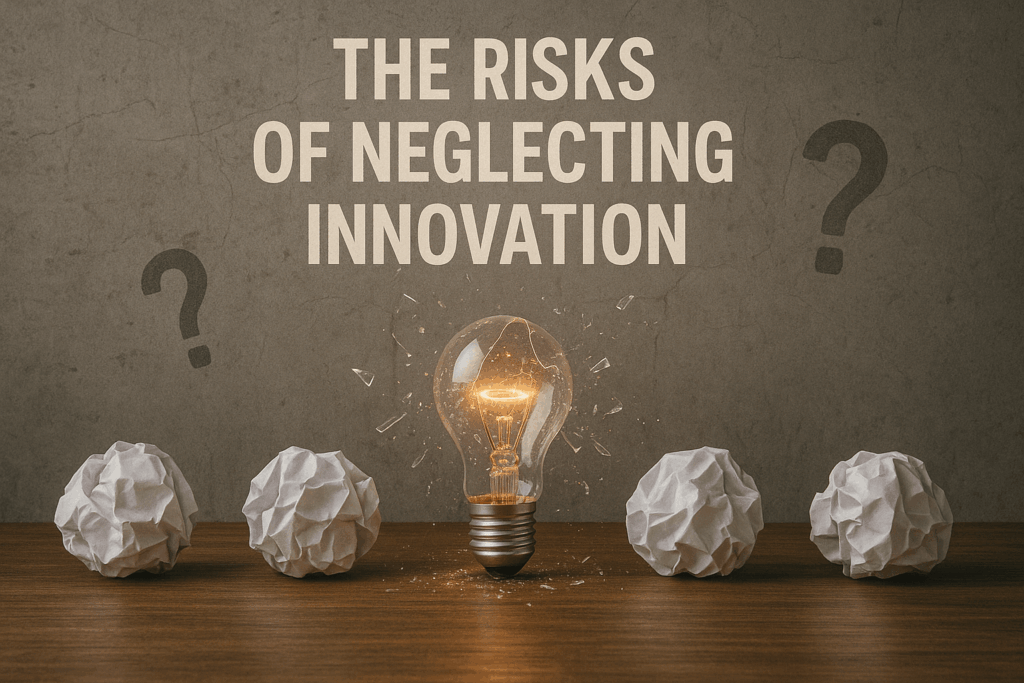
“The riskiest thing we can do is just maintain the status quo.” — Bob Iger, Media executive & businessman, former CEO of The Walt Disney Company
Companies that fail to create new ideas face severe consequences. The facts are clear – businesses that don’t keep up with changes risk becoming irrelevant.
Blockbuster’s unwillingness to change its sales approach directly caused its collapse. The company once ruled the video rental market but turned down a chance to buy Netflix, which later changed how people watch entertainment. Similarly, Toys R Us didn’t adapt to online shopping and stuck to their physical stores while other companies succeeded online. Kodak, once worth $28 billion in 1996, went bankrupt by 2012 because they refused to adapt to digital photography, even though they created the technology themselves.
The financial damage from staying still often goes unnoticed but runs deep. Studies show only 10% of companies reach two-thirds of their strategic goals, and 67% of well-created strategies fail because of poor execution. Companies that focus on creating new ideas grow 16% faster than those that don’t.
Many businesses believe “if it ain’t broke, don’t fix it.” This mindset can get pricey—one company spent over $800,000 each year to maintain old server systems. Beyond direct costs, companies miss new markets, lose pricing power, and watch customer loyalty fade. Instead of clinging to outdated infrastructure, they could have upgraded to a modern residential proxy service to gather market research efficiently.
Psychology plays a big role in resisting change. Six main psychological factors shape how people decide to adopt new technology: personality, attitudes, motivation, social factors, cognitive processes, and organizational elements. These show up as fears of criticism, uncertainty, career damage, and loss of control.
Resistance also comes from old-school thinking, doubts about value, and fear of risk. Companies face what Clayton Christensen, a Harvard Business School professor known for his work on disruptive innovation, called ‘The Innovator’s Dilemma‘ — they focus too much on current success instead of building skills for future markets.
The biggest risk isn’t trying something new—it’s staying the same. This approach leads to irrelevance as customer needs grow beyond what businesses provide.
Research proves it – entrepreneurial breakthroughs are the lifeblood of business success, not just another buzzword. Companies that adopt breakthroughs grow twice as fast as their competitors and earn substantially higher profits.
Most businesses know innovation matters, yet very few of these companies feel good about their innovation results. This gap between knowing and doing creates opportunities for entrepreneurs who think ahead.
Smart business leaders know that breakthroughs don’t need genius-level creativity or cutting-edge technology. They just need methodical problem-solving and careful outcome tracking. Companies should balance quick wins with long-term projects while measuring metrics like R&D conversion rates and pipeline health.
Businesses that ignore breakthroughs face tough consequences. Blockbuster and Kodak showed this clearly. Their stories remind us that staying still costs more than embracing change.
Want to start your experience with innovation at its heart? A partnership with WIN Home Inspection, the nation’s most innovative inspection franchise, could be your next step. Just fill out the interest form to connect with a franchise partnership manager.
Facts tell the story – businesses that prioritize breakthroughs set themselves up for eco-friendly growth and market leadership. Others risk becoming examples of missed chances and market failure.
Entrepreneurial innovation is the process of developing new ideas or improving existing products, services, or business models to solve customer problems. It starts with identifying a gap in the market and finding a practical way to address it. Entrepreneurs use innovation to create value, improve customer experiences, and build businesses that stand out from competitors.
Innovation helps entrepreneurs solve customer problems, improve business operations, and stay competitive. It allows businesses to adapt to changing customer needs, reduce costs, and explore new revenue opportunities. Without innovation, businesses risk falling behind competitors. Entrepreneurs who consistently improve their products, services, and processes can attract more customers and build a stronger position in the market.
Examples of entrepreneurial innovation include developing new products, introducing subscription-based services, automating business operations, and using AI to improve customer support. Companies like Uber changed how people book rides, while Netflix transformed how audiences watch entertainment. Small businesses also innovate by offering online bookings, faster service, or personalized solutions that make customers’ lives easier.
No. Entrepreneurs don’t need groundbreaking ideas to build successful businesses. Many succeed by improving existing products, offering better customer service, or adopting proven business models. Franchising is a good example. It allows entrepreneurs to start with an established business model while finding new ways to serve local customers, improve operations, and grow their businesses.
Franchise owners can innovate by adopting new technologies, improving customer experiences, and finding better ways to reach local customers. They can use digital marketing, automate daily tasks, and introduce services that meet changing customer needs. For example, home inspection franchise owners can use advanced inspection tools and digital reports to improve service quality and build stronger customer relationships.