

Ready to Embark on an Exciting Journey with WIN?
Take the first step toward personal and financial freedom by filling out the interest form. One of our franchise advocates will be in touch with you soon!


Once you become a home inspector, there will be several things to complete on your list of business decisions. One of the first is your rates. Setting your prices is one of the most pressing, yet can be one of the easiest to get wrong.
Charge too little and you fill your calendar with jobs that barely cover your time, insurance, and fuel. Charge too much before you have reviews and agent relationships, and the phone stays quiet while you wait for the market to notice you.
Not to worry. There is good news: you don’t need to guess. Nor should you.
Home inspection pricing follows fairly predictable patterns. Rates are driven mostly by the size and age of the house, the services a client adds, and what your local market will support.
This guide covers typical fees for standard inspections and common add-on services, explains what pushes a price up or down, and walks you through building a fee schedule that pays you properly for the work.
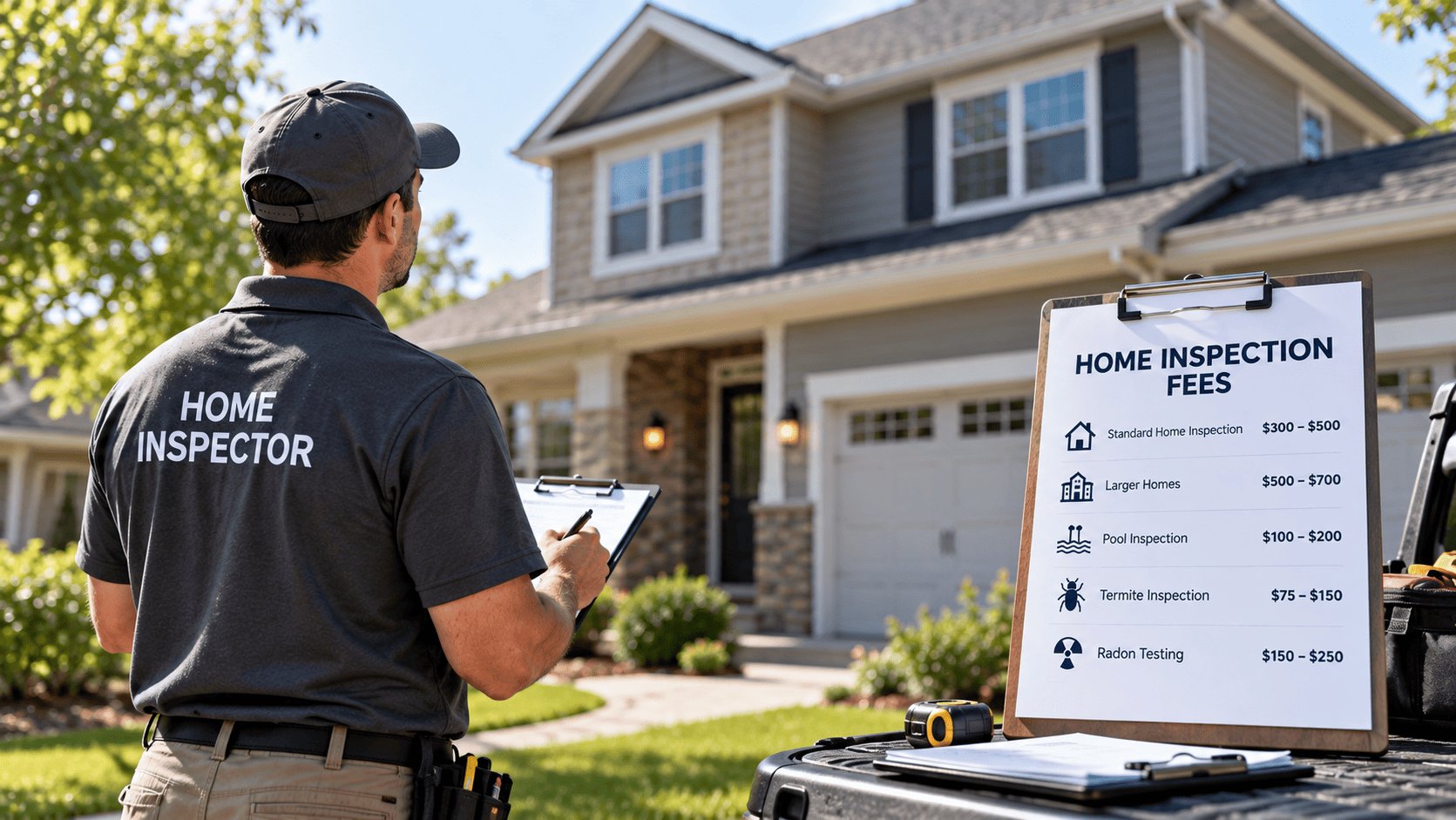
For a standard single-family home, most inspections in the U.S. cost between $300 and $500.
Data from 2026, based on 34,000+ verified projects, places the national average at $344, with most homeowners paying between $296 and $425.
The most common starting point when setting a price is the square footage. Here is how those 2026 averages break down by home size.
| Home size (sq. ft.) | Typical fee (2026) |
|---|---|
| Under 1,000 | $200-$250 |
| 1,000-1,500 | $225-$325 |
| 1,500-2,000 | $250-$375 |
| 2,000-2,500 | $275-$400 |
| 2,500-3,000 | $300-$500 |
These figures are intended to be a research baseline rather than a target. National averages blend small condos, budget operators, and lower-cost rural markets with full-service firms in expensive metros. Meaning, established inspectors in many areas charge well above these averages.
Homes over 3,000 square feet usually call for custom pricing, and in some regions the gap is significant. Local guides in North Carolina’s Triad, for example, report that a standard inspection for 4,000-plus square foot homes costs $650 to $950.
There can be two inspectors in the same city that quote very different fees, even for the same house. Most of the time, they have a reason for setting that price.
Here are some of the variables that drive up the price of home inspection rates:
When running a home inspection business, you have the opportunity to make more income through add-on services. You sell them at the same appointment, so the added revenue comes without a second drive or a second booking.
Published 2026 cost guides show fairly consistent ranges for the most common add-ons.
| Add-on service | Typical fee when added to an inspection |
|---|---|
| Radon test (short-term, continuous monitor) | $125-$250 |
| Sewer scope | $150-$300 |
| Termite / wood-destroying organism (WDO) | $75-$150 |
| Mold sampling with lab analysis | $300-$650 |
| Pool and spa inspection | $100-$300 |
| Well water testing | $100-$400 |
| Lead paint testing | $250-$400 |
Sources: Inspector Data, add-on cost guide (2026) and HomeInspectionCost.net, specialized inspection costs (2026)
Before you build these into your fee structure, note the following:
A buyer’s pre-purchase inspection is the basis of most fee schedules, but it should not be the only line on yours.
These are the other inspection types you can price, along with how inspectors usually approach them.
| Inspection type | How it is usually priced | Notes |
|---|---|---|
| Pre-listing (seller) inspection | Same as a buyer’s inspection | Same scope and report; some inspectors offer a small discount to build listing-agent relationships |
| New construction final | About $280-$400 per Angi | Similar to a standard inspection for the same size home |
| Pre-drywall and 11-month warranty | Flat fee, often below a full inspection | Shorter visits with a narrower scope; many inspectors sell them as a package with the final |
| 4-point insurance inspection | About $75-$150 per Kin | Common in Florida for older homes; covers roof, electrical, plumbing, and HVAC |
| Wind mitigation inspection | About $75-$150 per Kin | Often bundled with a 4-point for roughly $150-$250 |
| Re-inspection of repairs | Flat return-visit fee | Should cover your drive plus at least an hour of time |
As for insurance inspections, yes, fees are lower, but they take far less time than a full inspection. In states like Florida, they give you a steady stream of work from homeowners who are not buying or selling.
Bundled with a buyer’s inspection, they also raise the value of the appointment without adding much time on site. So, once you scale this service, it can be a reliable, consistent income source.
National averages tell you what clients are used to paying. They do not tell you what your business needs to charge, and that number comes from your own costs, your time, and your local market. Working through these steps in order will give you a fee schedule you can defend.
List everything the business pays for in a typical month, including errors and omissions and general liability insurance, reporting software, license renewals and continuing education, vehicle and fuel, equipment replacement, phone and website, marketing, and any franchise or association fees. Then add a realistic set-aside for taxes.
A standard inspection usually takes 2-4 hours on site, but that is only part of the work. Add the drive, the report writing, and the follow-up calls with the client and agent. Many inspectors find that a single job takes five to seven hours from start to finish.
Look at the websites and online schedulers of eight to ten inspectors in your area and note their base fees by home size, their age and crawlspace charges, and their add-on prices. You are looking for the range, not the cheapest number in it.
Most inspectors use a base fee by square footage tier, adjustments for older homes, crawlspaces, and travel, a menu of add-ons, and a few bundles that pair popular services at a modest discount.
Insurance, fuel, and software costs rise, and so does your reputation. An annual review keeps your fees in step with both.
Here is an example showing why this math matters:
Suppose your fixed costs come to $2,500 a month and you complete 15 inspections. Each job has to cover about $167 before you earn anything for yourself. At a $325 fee, you keep roughly $158 per inspection for five to seven hours of work, before taxes. At $425, that figure climbs to about $258, which is a very different business for the same effort. Your own numbers will differ, but running them is the only way to know whether a price actually works.
Most pricing problems in this industry come from the same recurring habits. Avoiding them early is much easier than fixing them after a year of underpriced work.
A standard home inspection in the U.S. typically runs $300 to $500, and add-on services can push a single appointment well past that. Those numbers are a useful starting point, but the right price for your business depends on what it costs you to operate, how long each job really takes, and where you want to sit in your local market.
Price for the value you deliver, not for the cheapest competitor in town. A clear fee schedule, a well-chosen menu of add-ons, and a habit of reviewing your rates every year will do more for your income than any single discount ever could. As your reviews and agent relationships grow, your pricing should grow with them.
If you are planning to start a home inspection business and would value franchise guidance along the way, WIN Home Inspection offers a free, no-obligation consultation to help you think through your market, your pricing, and your next steps.