You find the perfect house, and the backyard has a cute little rental unit that could cover part of your mortgage every month. Then you learn something that stops you cold. One peer-reviewed study found that 78.2% of the detached backyard units built in San José between 2016 and 2020 were never permitted. That little income machine could quietly become your biggest headache the day you get the keys.
So the real question with any backyard unit comes down to this. Is this ADU legal, and if it is not, what will fixing it cost you? An unpermitted or poorly built unit can freeze your loan, get an insurance claim denied, come up short on the appraisal, and land on you as a brand new liability. By the end of this guide you will know what to check, what it costs, and when you should just walk away.
What Is an ADU?
ADU stands for accessory dwelling unit. In plain words, it is a small second home that sits on the same lot as a regular single family house. It has its own kitchen, its own bathroom, a place to sleep, and its own door to the outside. It is always the smaller of the two homes on the property.
People call these units by a whole pile of names, which is part of why they are so hard to track. You might hear granny flat, granny unit, in-law suite, mother-in-law suite, casita, secondary suite, garage apartment, backyard cottage, carriage house, or just second unit. When one was built without permits, folks sometimes call it "shadow housing."
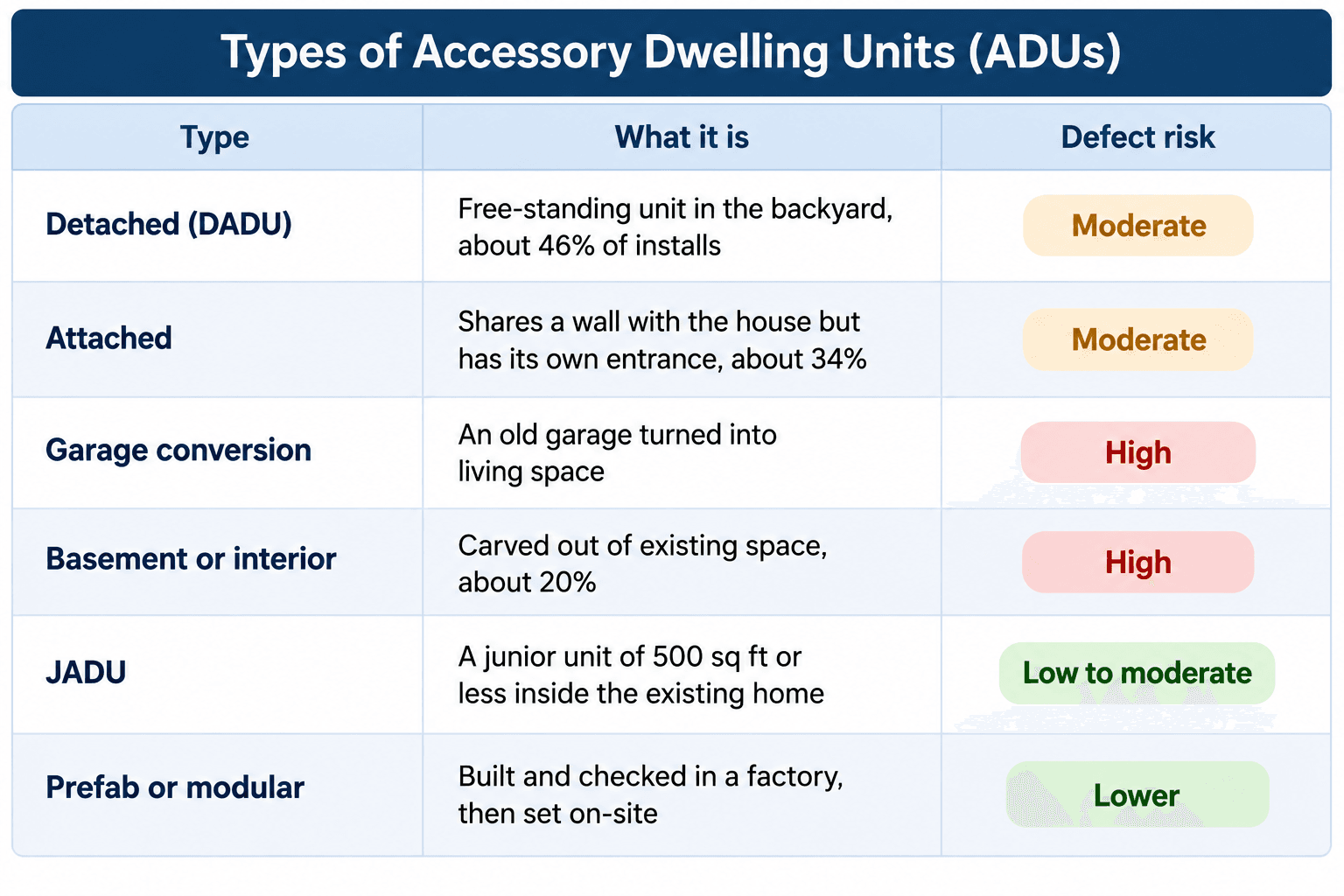
Types of ADUs
The type of unit tells you a lot about how much risk you are taking on.
Why ADUs Are Booming (and Why That Is a Buyer's Problem)
Backyard units are showing up everywhere now. Freddie Mac counted about 1.4 million US properties with an ADU. In California the growth has been wild. The state went from 1,336 ADU permits in 2016 to 26,924 in 2023, and by that year ADUs made up more than a fifth of every home permitted across the whole state.
Here is the part that should make a buyer sit up. A 2023 Freddie Mac survey found that 71% of people did not really know what an ADU was, and about a third got interested once they learned. So the market is huge, it is growing fast, and most of it is undocumented. That means the job of checking whether a unit is actually legal lands on you, the buyer.
Why an ADU Inspection Is Not a Normal Home Inspection
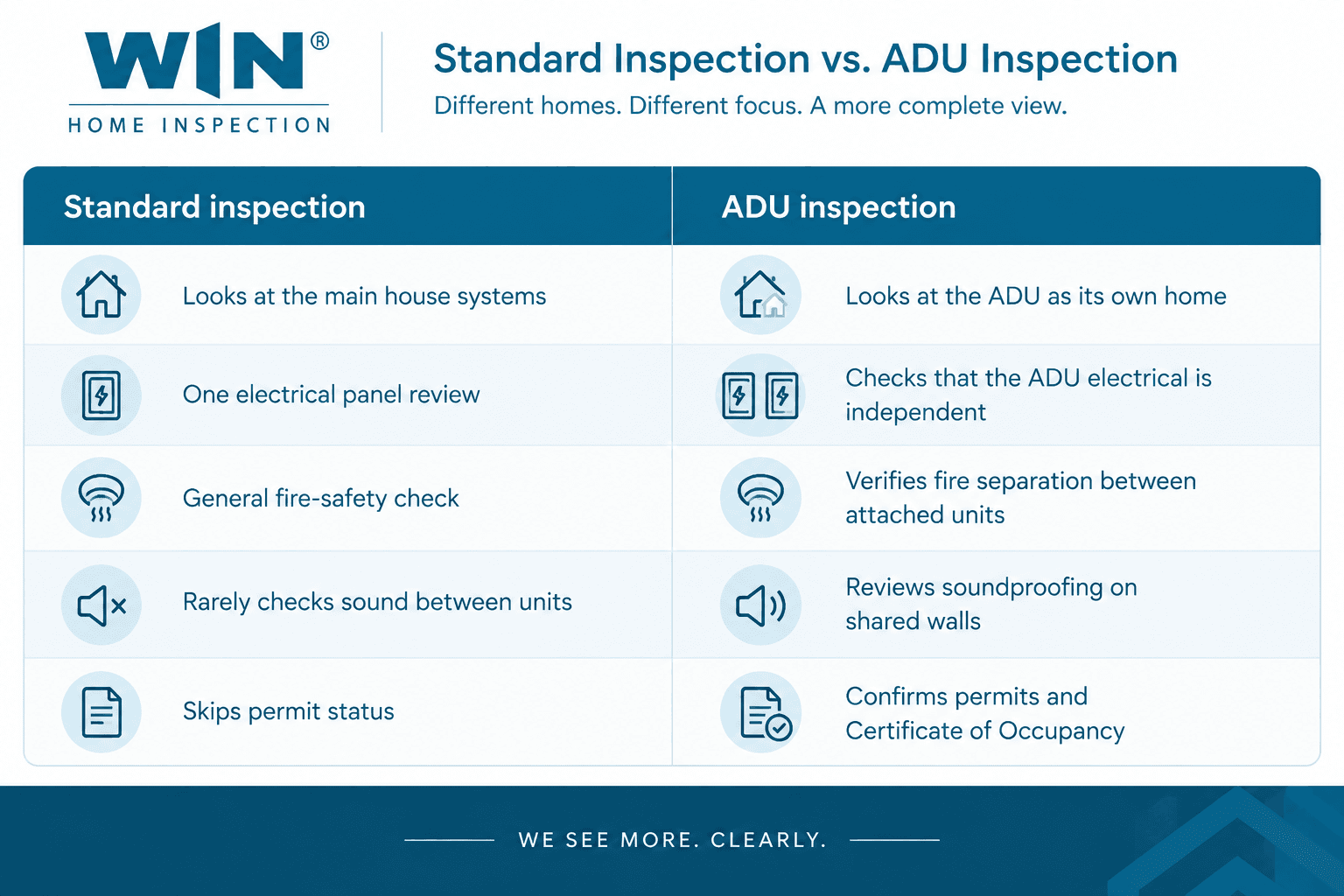
Here is the mistake most people make. They treat the backyard unit as a fun bonus feature stapled onto the main house. Please do not do that. Treat the ADU as a second home inspection all by itself. It has its own electrical, its own plumbing, its own heating, and its own list of problems, and its condition is often very different from the main house next to it.
A regular home inspection follows the ASHI Standards of Practice, which is a solid baseline. But a generic inspector may skip the things that matter most for a second unit. That includes whether the electrical is truly separate, whether there is proper fire separation between attached units, whether the heating and plumbing stand on their own, and whether the permits and Certificate of Occupancy really exist. Knowing local ADU code is what separates a real ADU inspection from a lazy one.
Permitted vs. Unpermitted: The Detail That Matters Most
If you remember one thing from this whole article, make it this part. Permit status is the single most important detail in any deal with a backyard unit. It matters more than any crack in the wall or old water heater you might spot.
The "Open Permit" Trap
Here is the trap almost nobody warns you about. A permit that was pulled but never signed off, called an "open permit," gets treated exactly like no permit at all by lenders, insurers, and title companies. Inspectors run into this constantly. The owner paid the fees, a contractor pulled the permit, and then nobody ever came back for the final sign-off. So you have to check the actual status, not just whether some permit exists on paper.
How to Check a Permit Yourself
You can do most of this before you even make an offer.
- Search the city or county building department permit portal. Places like LADBS, Seattle SDCI, Portland, and Honolulu DPP all have one online.
- Look for "Final" status or "Certificate of Occupancy Issued." Do not settle for "Permit Issued" or "Approved," because those words do not mean the work actually passed.
- Use the real building records, not the tax or assessor data. Portland even warns people not to trust tax info for this.
- Compare the approved plans to what is really standing there, and make sure the unit count on record matches what you see with your own eyes.
What Happens If It Was Never Permitted
An unpermitted unit can hit you in several ways at once.
- Many California cities charge up to $1,000 a day until it is resolved. Seattle goes up to $500 a day, plus stop-work orders and even forced removal.
- Lenders may refuse, and unpermitted square footage cannot count as living space, so the appraisal may fall short of your loan.
- Carriers may deny coverage for a structure that was never permitted or inspected.
- You will get lower offers, you must disclose it, and hiding it can bring fraud liability.
And enforcement is climbing. In LA County, ADU code-violation cases jumped from 16 a year in 2018 to 53 a year in 2023, which is a 230% surge.
What an ADU Inspection Actually Covers
This is the real meat of the job. A good inspector goes system by system. Here is what they look at and why each one can bite you.
The structure and foundation:
Foundations should reach deep enough to be safe. In the City of LA, that means at least 12 inches below grade. Old garage slabs often skip the moisture barrier and sit too shallow for a real home. Rotted wood or weak beams can quietly turn a conversion into a teardown.
Electrical:
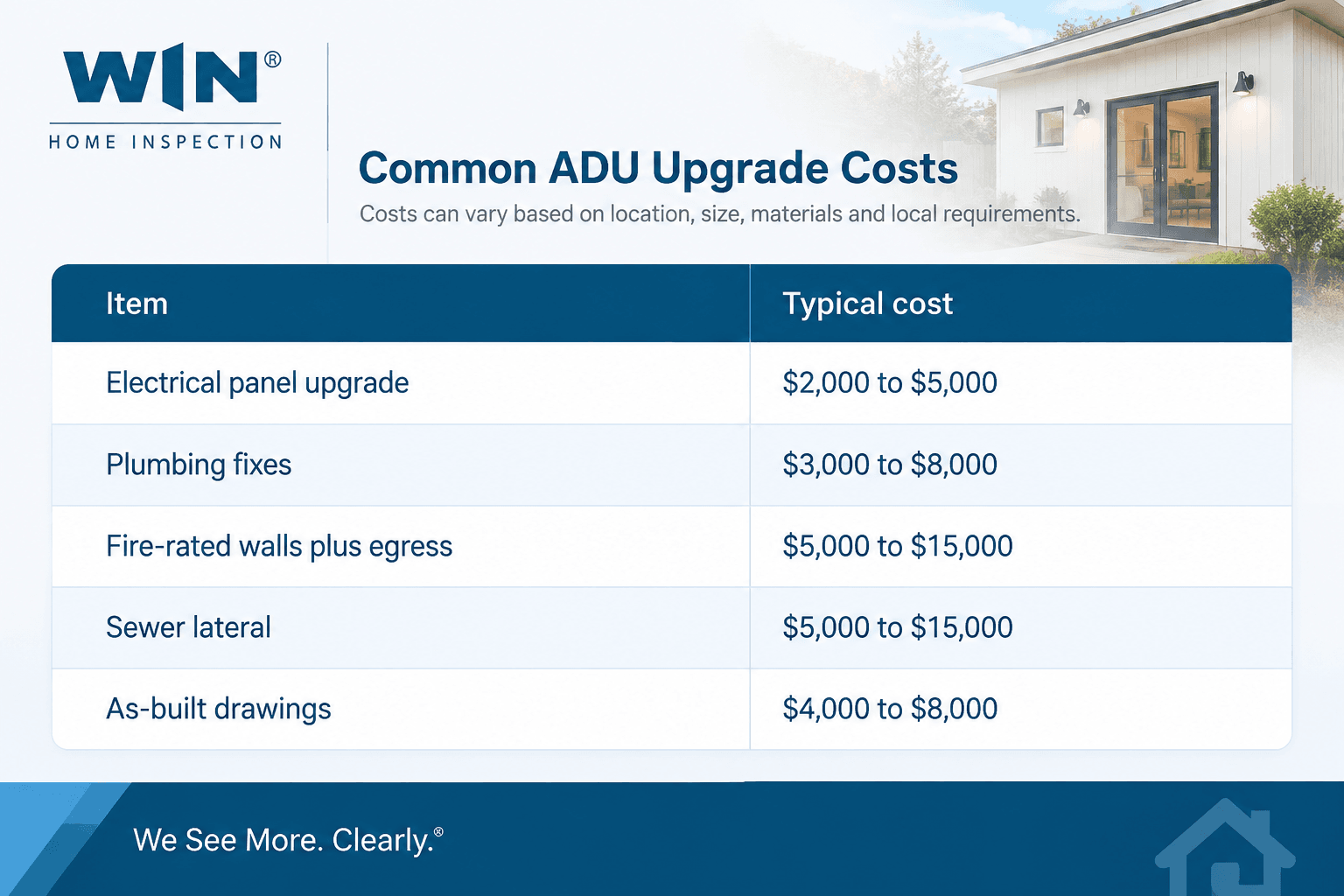
This is one of the biggest problem areas by far. The unit's circuits must be fully separate from the main house, and all new circuits need AFCI protection. An old garage was wired for a single 20-amp circuit to run a light and a door opener, which cannot power a real home with a kitchen and heat. Most units need at least a 100-amp subpanel, and that upgrade runs about $2,000 to $5,000.
Plumbing, sewer, and septic:
Most ADUs tie into the main home's sewer line. Ask for a sewer scope, which costs about $200 to $500 and can save you from a truly nasty surprise. A new sewer lateral can run $5,000 to $15,000, and septic work can climb even higher. Water pressure should stay at or below 80 PSI.
HVAC:
A detached unit needs its own heating, cooling, and hot water. Small systems get worked hard, and a sloppy install fails fast once winter hits.
Roof, insulation, and airflow:
Garage walls are often too thin for the insulation the code wants. If there is no ventilation system at all, that is a bright red flag for an illegal conversion.
Doors, windows, and escape:
The main door should be at least 36 inches wide and 80 inches tall and open straight to the outside. Every bedroom needs an escape window big enough to climb out of during a fire. Living spaces need ceilings at least 7 feet high, which trips up a lot of basement conversions.
Fire safety:
Attached units usually need a 1-hour fire-rated wall and ceiling between the two homes, plus smoke and CO alarms that talk to each other. The 2024 code adds some flexibility when both units' alarms trigger together.
Sound:
Shared walls and floors are supposed to block noise to a set standard. Thin walls are one of the most common complaints inspectors and tenants report.
Moisture and water drainage:
Small units have almost no room for error. Poor grading, missing vapor barriers, and old water damage all tend to show up here.
Garage-Conversion Red Flags
Garage conversions are the trickiest type, so learn to spot the tells yourself before your inspector even shows up. Keep an eye out for these signs.
- A garage that no longer looks like a garage, with finished walls, carpet, recessed lights, a fridge, or a closet.
- More rooms than the older Zillow or Redfin photos showed.
- A small backyard building that has power, plumbing, AC, and a bed inside.
- Electrical that clearly does not match the rest of the house.
- No ventilation, plus cheap or sloppy workmanship.
Why are they so risky? Garages usually have weak electrical, thin walls, no slab moisture barrier, shallow foundations, floors that slope toward the old garage door, and low ceilings. On top of that, the covered parking is gone, and the permits are often missing.
What It Costs: Inspection, Repairs, and Legalization
Here is the good news and the bad news at the same time. Checking a unit is cheap, but fixing one is not.
A standard home inspection averages about $343 nationally, with most falling between $296 and $424. A home with an ADU is basically two inspections, so plan on roughly $200 more per unit, plus any add-ons like a sewer scope. The whole visit takes 2 to 4 hours, and you usually get the report within a day.
Now for the repairs.
And here comes the big one. Making an unpermitted unit legal usually costs $25,000 to $60,000 for a clean but noncompliant unit. It can start around $10,000 and climb past $120,000 when there are major code gaps. Retroactive permit fees often run 2 to 3 times the normal rate.
So sit with that math for a second. A $343 inspection can flag a $60,000 problem before you ever sign a thing. That really is the cheapest insurance in the whole deal.
Financing, Appraisal, and Insurance
This part changed a lot recently, so pay close attention to the dates. None of this is financial or legal advice, so always confirm the details with your own lender and agent.
Financing:
As of early 2026, Fannie Mae (in announcement SEL-2025-08), Freddie Mac, and FHA all let you count ADU rental income toward qualifying for a loan on an eligible one-unit primary home. The common rule is about 75% of the rent, capped near 30% of your total income. These rules shift often, so check the current numbers with a lender before you count on them.
Appraisal:
To count that ADU income, appraisers use a form called the 1007, and they weigh things like separate meters, a separate address, and whether the unit can legally be rented. The FHFA began adding ADU data to its appraisal dataset back in 2023.
Insurance:
This is the gap that catches so many people off guard. A detached ADU usually falls under "other structures" on your policy, which is often only about 10% of your dwelling coverage.
Say your home is insured for $350,000. Your detached backyard unit might be capped at only about $35,000. But rebuilding that unit could easily cost more than $150,000. That leaves a six-figure hole you did not even know you had.
If you rent it out, you need a separate landlord policy. And an unpermitted unit can get a claim denied outright, which turns a bad day into a financial disaster.
Codes and State Laws, Kept Simple
Codes shift by state and city, so here is the short version. The International Residential Code is adopted in 49 of the 50 states, though the exact edition and local tweaks vary. The strongest ADU laws live in California, Washington, Oregon, and Colorado, and more than 20 states now have statewide ADU rules on the books.
A few fresh examples worth knowing:
- California passed AB 1154 and SB 543, both taking effect in 2026.
- California AB 2533 lets owners legalize many units built before 2020 without a big penalty.
- Washington's HB 1337 allows 2 ADUs per lot and dropped its owner-occupancy rule.
One rule never changes, no matter where you live. Always confirm with your local planning department. State law cannot capture your exact lot, its setbacks, its utility limits, or your HOA rules.
Your Action Plan: Before, During, and After
Break the whole thing into three simple stages.
Before the inspection day:
Pull the permit history, the final inspection or Certificate of Occupancy, and the seller's disclosure. Do this early, before your inspection contingency runs out. Compare the current listing photos to older ones online to catch any rooms that got quietly added.
During the inspection visit:
Show up in person if you can. Make the inspector walk the ADU's own systems with you, checking electrical independence, fire separation, escape windows, heating, and the sewer or septic tie-in.
After the inspection wraps:
Go over the findings with your agent. Get real repair and legalization estimates. Call your insurance carrier to confirm you can actually cover the unit. Then you can negotiate credits, ask for repairs, or walk away while you still hold some leverage.
How to Pick an ADU Inspector
Ask a few pointed questions before you hire anyone. Are they certified by ASHI or InterNACHI? Do they carry errors and omissions insurance? Have they completed 500 or more inspections? Do they actually know local ADU code? Will they inspect the ADU as its own unit, research the permit history, and check the sewer lateral or septic? A confident yes to those is exactly what you want to hear.
Key Takeaways
Three ideas are worth carrying with you into any deal.
First, permits matter more than anything else, so confirm the "Final" status, not just the paperwork sitting in a folder.
Second, treat the backyard unit as a second inspection with its own systems and its own risks.
Third, it is cheap to check and expensive to fix, so a few hundred dollars today can catch a five-figure problem tomorrow.
Ready to move forward with confidence? Book an inspection with someone who truly knows ADUs, and grab a free ADU inspection and permit-verification checklist so nothing slips past you.
Frequently Asked Questions
Ques 1: Do I need a separate inspection for an ADU?
Ans 1: Yes. It runs on its own systems, so it should be checked as its own home, not as a tiny footnote to the main house.
Ques 2: How do I check if an ADU was permitted?
Ans 2: Search your city or county permit portal for the building permit and the final inspection or Certificate of Occupancy. Remember that an open permit counts as no permit.
Ques 3: Will my homeowner's insurance cover a detached ADU?
Ans 3: Usually only about 10% of your dwelling coverage, which is often way below the rebuild cost. You will likely need extra coverage, and a rental needs its own landlord policy.
Ques 4: Can I convert my garage to an ADU without a permit?
Ans 4: No. It risks fines, denied insurance, and big problems when you try to sell or refinance later on.
Ques 5: Can ADU rental income help me qualify for a mortgage?
Ans 5: As of 2025 and 2026, often yes. Lenders may count about 75% of the rent, capped near 30% of your income. Confirm the current rules with your lender.
Ques 6: I am buying a home with an unpermitted ADU, so what to do now?
Ans 6: Get it inspected, confirm you can insure it, price out legalization or removal, talk to the building department and a contractor, then renegotiate, legalize, or walk.
Ques 7: How long does an inspection take and what does it cost?
Ans 7: Around 2 to 4 hours, and roughly $343, plus about $200 per unit and any add-ons like a sewer scope.