







Do you know when your air filter was last changed? Most people don't, and that's normal, it's easy to overlook. But it's worth checking, because a fresh filter makes a real difference: rooms feel more comfortable, dust stays away longer after you clean, and your HVAC doesn't have to work as hard to keep up. If you just bought the house, learning how to change your air filter is a good place to start.
According to the U.S. Department of Energy, replacing a clogged filter can reduce an air conditioner’s energy use by 5% to 15%. For a homebuyer, a heavily coated filter may raise questions about how consistently the HVAC system was maintained.
Changing the filter is usually simple. Finding it, choosing the right size, and pointing the airflow arrow correctly can be less obvious. This guide and the short video below walk you through each step.
Why Regular Air Filter Replacement Matters
Your heating and cooling system keeps pulling household air back through its equipment. The filter sits in that return path and catches the everyday mess moving with it: dust, lint, pet hair, and other small particles.
A dryer lint screen offers a useful comparison. A light coating is normal. Leave it too long and the open surface disappears under a gray mat. The same thing happens here. Once dirt fills the filter, the fan has less open material to pull air through. You may notice weaker vents first. Or one room that never quite catches up.
There is a limit to what a new filter can do. It won't seal a loose duct, fix a weak fan, or solve every air-quality concern. What it can do is support airflow, reduce indoor air pollutants and keep some debris away from the equipment.
What You Need to Do to Change an Air Filter
This is a short-tool-list job. Set the new filter nearby, open a bag for the old one, and have a cloth or vacuum ready for the edge of the slot.
Compare the labels before opening the new filter. A 16 x 20 x 1 filter is not interchangeable with the closest-looking box. If the print is faint, take a photo and zoom in.
A replacement with the same printed size and approved type
A marker or phone reminder for the date
A bag for the dusty filter
A dry cloth or vacuum
A screwdriver or stable step stool, if needed
The equipment manual, if anything is unclear
How to Change Air Filter in House: Six Steps
Here are a few steps to change your air filter at home:
Step 1: Turn Off the HVAC System
Set the thermostat to Off, then wait until the fan stops. Don't rush this part. With the fan running, loose dust can be pulled through the empty slot. Your unit may also have a service switch, or its manual may call for the breaker to be turned off before opening a cover. Follow the directions on that equipment.
If access exposes wiring, sharp metal, or moving parts, close the panel and call a professional. That is no longer a routine filter change.
Step 2: Locate the HVAC Air Filter
Start beside the furnace or indoor air handler - the indoor cabinet that contains the fan and cooling parts. Look for a narrow slot where the return duct meets the cabinet. It may have a small cover. A thick filter usually sits inside a wider, obvious cabinet of its own.
No filter beside the unit? Look behind the large grilles on the walls or ceiling. Those are often return grilles, which pull room air back toward the equipment. The filter may be sitting right behind one. And take a slow walk through the house. Two systems usually mean two filters; some homes have several filtered returns.
Step 3: Check the Filter Size and Type
Read the numbers on the frame. They usually appear as length x width x thickness, such as 16 x 20 x 1. Buy that printed size. The actual filter may measure a little smaller because box sizes are often rounded. Copy the label rather than rounding your own measurement.
Check the type too. Most thin fiberglass and pleated filters are disposable; reusable filters say so on the frame. Note the MERV number if one is printed. We will explain that rating later. For now, the safest choice is to match what the system already uses. In any how to change air filter guide, matching the printed size matters more than rounding a measurement.
Step 4: How to Replace an Air Filter Safely
Before you pull anything out, take a photo. Get the old arrow and the edge of the slot in the frame. Yes, it can feel unnecessary. Then the old filter is on the floor, the new one is in your hand, and both directions somehow look correct. These are also the basic steps for how to replace the air filter safely without spreading dust through the house.
Pull the filter out slowly and bag it if it is heavily coated. Wipe or vacuum the accessible rim of the slot, but do not reach into the cabinet.
Step 5: Install the New AC Air Filter in the Correct Direction
Find the airflow arrow on the new filter and point it toward the equipment. Behind a return grille, that usually means away from the room and into the duct. If the layout makes you pause, use the photo you took. That was the point of taking it.
Ease the filter into the track. It should slide in and sit flat. If the frame bends, pull it out, check the size and wrapper, then line it up again. Don't force it.
Step 6: Complete the Air Filter Replacement
Put the grille or cover back before restoring the power. Then return the thermostat to its normal setting and listen. A new whistle may mean the filter is sitting crooked, the cover is loose, or the filter is too restrictive. A rattle deserves another look as well.
Before you walk away, write the date on the frame. Save the size of your phone, too. It takes ten seconds now and avoids standing in a store later, staring at a row of nearly identical boxes. You have now completed the core how to change air filter process.
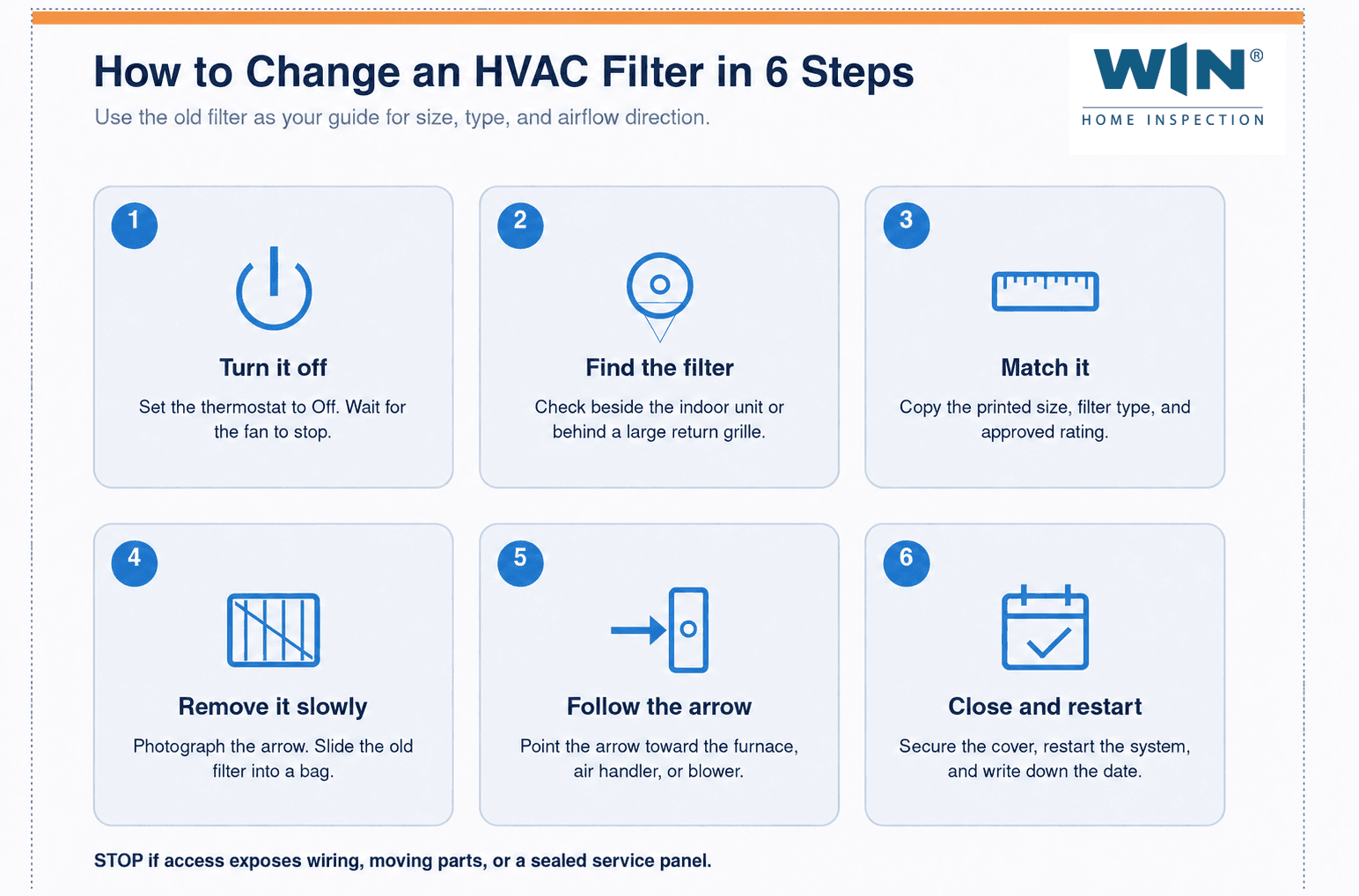
At a glance: Switch the system off. Find the filter and note its size, type, and arrow direction. Ease the old filter out, clean the edge of the opening, and slide the matching replacement in with its arrow pointing toward the equipment. Close the cover before turning the system back on. If you are asking, “how do you change the air filter?” use this how to change air filter checklist as your quick reference.
Which Direction Should an HVAC Air Filter Face?
The one rule: Point the airflow arrow toward the furnace, air handler, or blower. For a filter behind a return grille, the arrow usually points away from the room and into the duct.
Many filters have a support grid on the side facing the equipment. It helps the material hold its shape while the fan pulls air through. Install it backward and the filter may bow. If the old arrow has faded, look for one on the cabinet or check the manual. A guess saves a few seconds and can create a second trip back to the filter.
How Often Should You Change an Air Conditioner Filter?
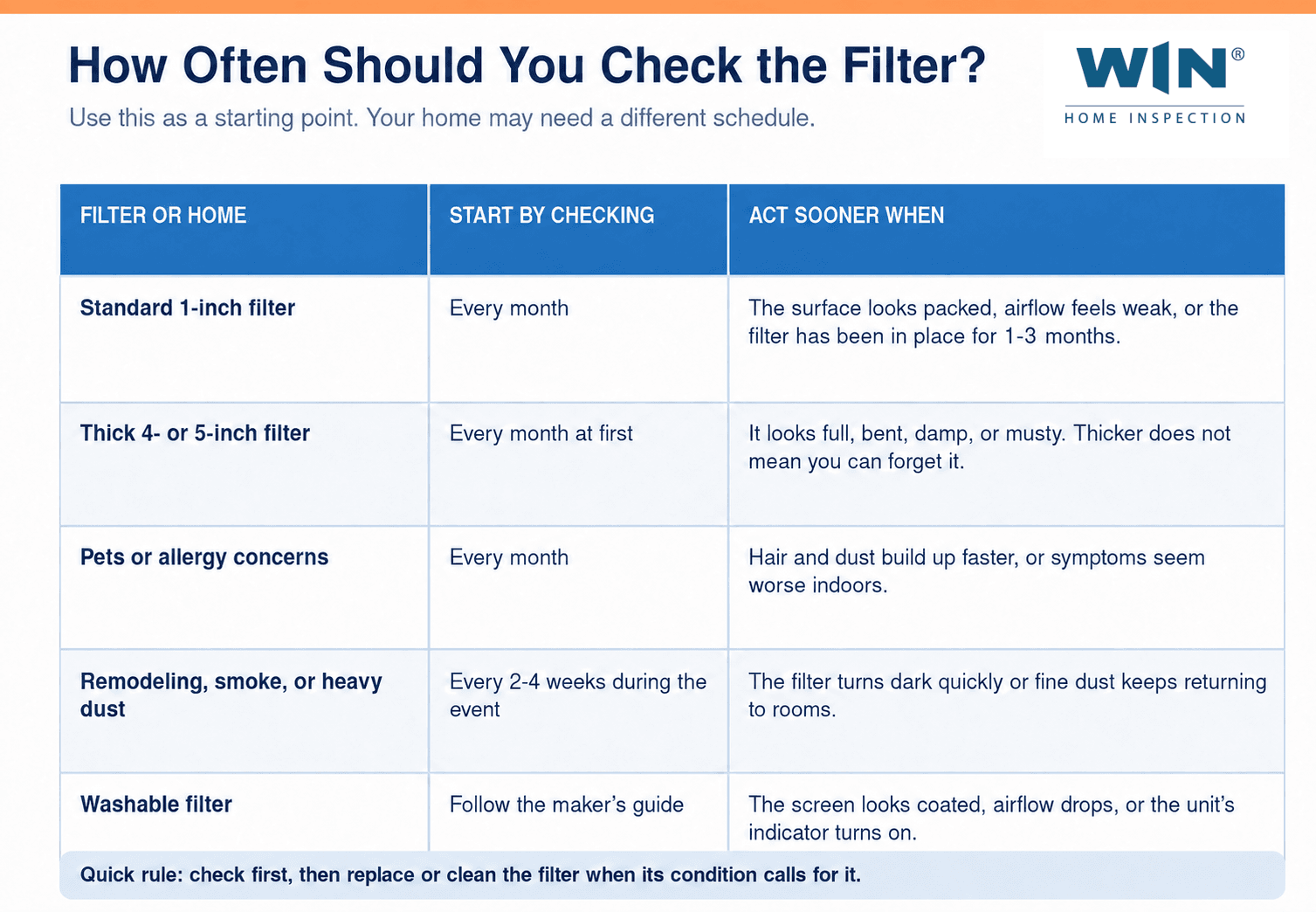
A one-inch disposable filter may need replacing every one to three months, but that range is only a starting point. Check it monthly during periods of heavy heating or cooling. ENERGY STAR also recommends regular filter checks when the HVAC system is working harder.
Your household conditions determine the actual schedule. Pets, smoke, renovation dust, nearby construction, and long fan run times can clog a filter sooner. Thicker filters may last longer, but they still need to be checked.
If you recently moved into a home, inspect the filter monthly for the first season. This will help you learn how quickly it collects debris under normal use. Knowing when to check the filter matters just as much as knowing how to replace it. For additional seasonal care, follow these steps to maintain your air conditioner.
How Can You Tell If an HVAC Filter Needs Replacing?
Take the filter somewhere with good light. A little gray is normal, but dust and hair packed across the surface may mean it is time for a replacement. If you are unsure, compare it with a clean filter. The difference is usually easy to see. During a 4-point inspection, the inspector also reviews the HVAC system’s visible condition and may note concerns that need further evaluation.
The house may offer other clues. None proves that the filter is clogged, but several together make it worth checking:
Several vents feel weaker than usual.
Rooms remain uneven during long HVAC cycles.
Dust returns soon after cleaning.
The filter has bowed, torn, or pulled away from its frame.
A musty odor appears near the return or equipment.
The recommended replacement period has passed.
Do not ignore moisture: A damp filter is not simply a dirty filter. Replace it, then look for the source of water or condensation. Repeated dampness, staining, or visible growth around the equipment should be assessed by a qualified professional.
How to Choose the Right Air Filter Replacement
A dependable on how to change air filter routine starts with a replacement that fits the slot and suits the equipment.
Match the Filter Dimensions
Copy all three numbers from the old frame. Don't round them. A small filter leaves room for air to slip around the edges; a large one can bend or jam. If the old filter is missing, the equipment label or manual is a better guide than a tape measure and a guess.
Choose the Correct Filter Type
Fiberglass filters are thin and inexpensive. Pleated filters usually catch more debris, while deep media filters need a matching cabinet. Washable filters must dry fully before reuse. Never wash a disposable filter or stack two filters together.
Check the MERV Rating
MERV stands for Minimum Efficiency Reporting Value. Put simply, it measures how well a filter catches particles of different sizes. A higher rating can catch smaller particles but may restrict airflow in a system not designed for it.
The EPA suggests considering MERV 13 or the highest rating your system can accommodate. The second half of that sentence matters as much as the first. Check the equipment manual before moving to a denser filter. If airflow falls or a return begins to whistle after the change, switch to an approved option and ask an HVAC professional to review the setup.
Common Air Filter Replacement Mistakes
Most mistakes happen because the job looks almost too simply. A quick pause before closing the cover catches nearly all of them.
Pointing the arrow away from the equipment
Forcing the wrong size into the track
Raising the MERV rating without checking the manual
Leaving the plastic wrapper on
Washing a disposable filter
Reinstalling a washable filter while damp
Missing a second system or filtered return
Ignoring water, rust, ice, or repeated odors
When to change air conditioner filter: Require an HVAC Professional?
An accessible air filter is usually safe for a homeowner to replace. Diagnosing the HVAC equipment is different. If airflow remains weak after installing the correct filter, the system may have a dirty coil, blocked duct, fan problem, or electrical issue. Another filter change will not solve the underlying cause.
Contact a qualified HVAC professional when:
Reaching the filter requires opening a sealed panel or working near wiring or moving parts.
The system short-cycles, freezes, makes unfamiliar sounds, or still has weak airflow.
You notice water, rust, scorching, repeated odors, or a new filter that becomes dirty unusually fast.
A qualified HVAC professional can test the equipment and identify the cause. If you want a broader visual assessment of the home’s accessible systems, visit WIN Home Inspection to find a local inspector.
Conclusion: Change Your Air Filter with Less Guesswork
Your first filter change may take fifteen minutes. Most of that time goes into finding the slot and reading the tiny print on the frame. The next change should be much quicker. Save the size, set up a reminder, and keep a spare if you have room for one.
When the reminder comes up, look before replacing the filter automatically. Then remember the three things that matter: exact size, correct type, arrow toward the equipment. Close the cover. Turn the system back on. Listen for anything new. That's the whole job.
Frequently Asked Questions About Changing Air Filters
What happens if you never change your HVAC filter?
The filter keeps collecting dust until air has trouble passing through it. Your system may run longer, rooms may feel uneven, and dirt can reach the blower or indoor coil. Energy use may rise as the equipment works harder. In severe cases, restricted airflow can contribute to icing, overheating, or an early system failure. The timing varies, but ignoring the filter eventually becomes more than a housekeeping issue.
Can I run my HVAC without a filter for one day?
It is better to leave the system off until the correct filter is installed. Even during a short run, hair, dust, and other debris can move toward the blower and indoor coil. One day may not cause an immediate breakdown, but it adds avoidable dirt inside equipment that is harder to clean than a filter slot. Fit the replacement and close the cover before restarting the system.
Can I change the HVAC filter myself?
In most homes, yes. If the filter sits in an open slot or behind an accessible return grille, you can usually replace it yourself. Match the printed size and follow the airflow arrow. Stop if access requires opening a sealed panel or brings you near wiring or moving parts. Once you know how to change air filter safely, future replacements usually take only a few minutes.
What are signs of a clogged AC filter?
Start with the filter itself. A clogged one often looks dark, matted, or packed with dust and hair. Around the house, you may notice weaker airflow, longer cooling cycles, uneven room temperatures, or dust returning soon after cleaning. A whistling return can be another clue. These signs can have other causes, so check the filter first. If the problem remains after replacement, have the system inspected.

Related Articles
View All

Get the Latest Insights!
Sign up to stay up to date with latest tips, trends and updates from WIN.