



How to Become a
Home Inspector in
Kansas

Reviewed by Patrick Knight
Licensing Hub

Exploring a different state?

Switch states to see licensing requirements, steps, fees, and FAQs.

Getting Started

Your Path to Becoming a Home Inspector in Kansas

Kansas doesn’t license home inspectors. You can charge for an inspection tomorrow without a permit, a test score, or anyone at the state reviewing your qualifications.

That surprises most people, and it used to be different. Kansas did register inspectors for about five years before the law expired in 2013. Nothing has replaced it since. What didn’t go away is what buyers want from you, which is somebody who understands houses and can show it. Around here that comes down to your training, the certification you pick up, and how you handle yourself on a job.

Home inspectors with the tool bag at a home

Kansas Home Inspector
Licensing Requirements

So if the state isn’t asking for anything, what should you have before your first paid job?

Four things carry the weight: solid training, a certification buyers have heard of, insurance, and a business that’s properly set up. Agents ask about all four before they’ll send you a client. Getting there on your own takes time, and that’s where WIN comes in, because the training, the certifications, and the business setup show up together instead of one at a time.

Licensing Required

No, there isn’t one. Kansas has no home inspector license, and the old registration law ended in 2013 without a replacement.

Education Hours Required

None required by state law. Most training programs run somewhere between 60 and 120 hours.

Field Training Required

None required by state law. Riding along on real inspections is still how you actually learn the job.

Exam Required

None mandated by state law. National Home Inspector Exam (NHIE) is recommended.

Application Fee

No license means no license fee.

Fingerprinting

No. Background checks and fingerprinting are not required.

Continuing Education Hours

None required (no state license exists).

License Renewal Cycle

N/A. Kansas does not issue or renew state home inspector licenses.

THE PATH FORWARD

6 Steps to Become a Home Inspector in Kansas

Take the first step toward becoming a professional home inspector in Kansas. Here’s everything you need to launch a rewarding career.

https://wini.com/franchise/wp-content/uploads/2026/08/Steps.jpg

Nobody’s going to check, which is precisely why this one matters. A decent course walks you through roofs, foundations, framing, wiring, plumbing, and heating and cooling, then teaches you to write it up so a buyer can actually understand what you found.

Pick a program built on a recognized set of inspection standards. That becomes your rulebook, and it’s what agents assume you’re following. If you can find a course that gets you inside real houses, take that one. Reading about a cracked heat exchanger and spotting one in somebody’s basement are two different skills.

Nobody in Kansas can look up your license number, because you don’t have one. Your certification fills that gap. InterNACHI and ASHI are the two names clients tend to recognize, and both ask you to follow their standards and code of ethics.

There’s also the Kansas Association of Real Estate Inspectors, which is the local group and has pushed for state licensing more than once. Joining gets you in front of inspectors who already know the market you’re about to enter.

You don’t need the National Home Inspector Examination in Kansas, and plenty of good inspectors here never took it.

Still worth thinking about, especially early on when you’re up against somebody who’s been inspecting houses since 2005. It’s four hours and 200 questions covering home systems and inspection practice. It also travels, so if you ever work across the line in a licensed state, you’re partway there already.

Kansas won’t make you carry coverage. Skip it anyway and you’re gambling with your house.

General liability handles the day you break something or somebody gets hurt while you’re on site. Errors and omissions handles the call three months later when a client says you missed the water heater. That second one is where almost every claim against an inspector starts. Real estate offices usually want to see both policies before they’ll refer anybody, so build them into your startup budget.

Here’s where new inspectors get themselves in trouble. General home inspection is wide open in Kansas. Two of the add-on services everybody wants are not.

Radon testing is the big one. State law says anyone testing or fixing radon has to be certified through the Department of Health and Environment, and testing during a real estate sale specifically has to be done by a certified technician. Kansas also has some of the highest radon readings anywhere in the country, so clients ask about it constantly. Certification means training, a national exam, and a fee, and it lasts two years.

Pest inspections are the other one. If a wood-destroying insect inspection is part of a real estate transaction, Kansas requires certification for that work, so it goes to a licensed pest professional unless you go get certified yourself.

Kansas has no statewide business license, but you’ll still register the business itself with the Secretary of State. Most inspectors form an LLC and move on. Local rules are separate and vary quite a bit, so call the clerk in the city where you’ll be working and just ask.

Then comes the part no course covers. You need report software, a way for people to book you, a website, an agreement clients sign before each job, and some plan for meeting agents who’ll actually recommend you. Some inspectors piece all that together alone over a couple of lean years. Others would rather start with something that already works, and that’s what franchise ownership is for, with mentoring, marketing, technology, and training in 35+ added services included in the franchise model, so there are no outside schooling costs.

Kansas Market

Prepare for Kansas'
Unique Market

Kansas weather is hard on houses, and a lot of the state sits on ground that produces high radon. Published pay averages land in the high $50,000s, and two services keep local inspectors busy.

Radon Testing

Much of Kansas falls into the highest radon zone the EPA uses, and state law requires a certified technician to do the testing during a sale. Getting certified turns a question you’ll hear weekly into paid work.


Roof and Storm Damage

Hail and wind roll through often enough that roof condition is usually the first thing a buyer asks about, so being able to document storm damage clearly is worth real money here.

You Don't Have to Figure This Out Alone

Getting licensed is just the first step. WIN backs you up with a proven brand, a national footprint, and decades of real operating experience, so you can focus your energy on growing the business, not figuring it out alone.

#1 Ranked

Home Inspection Franchise
For Four Years In A Row

41,000+

Positive Google Reviews
From Happy Clients

45 States

Presence Across
The Nation

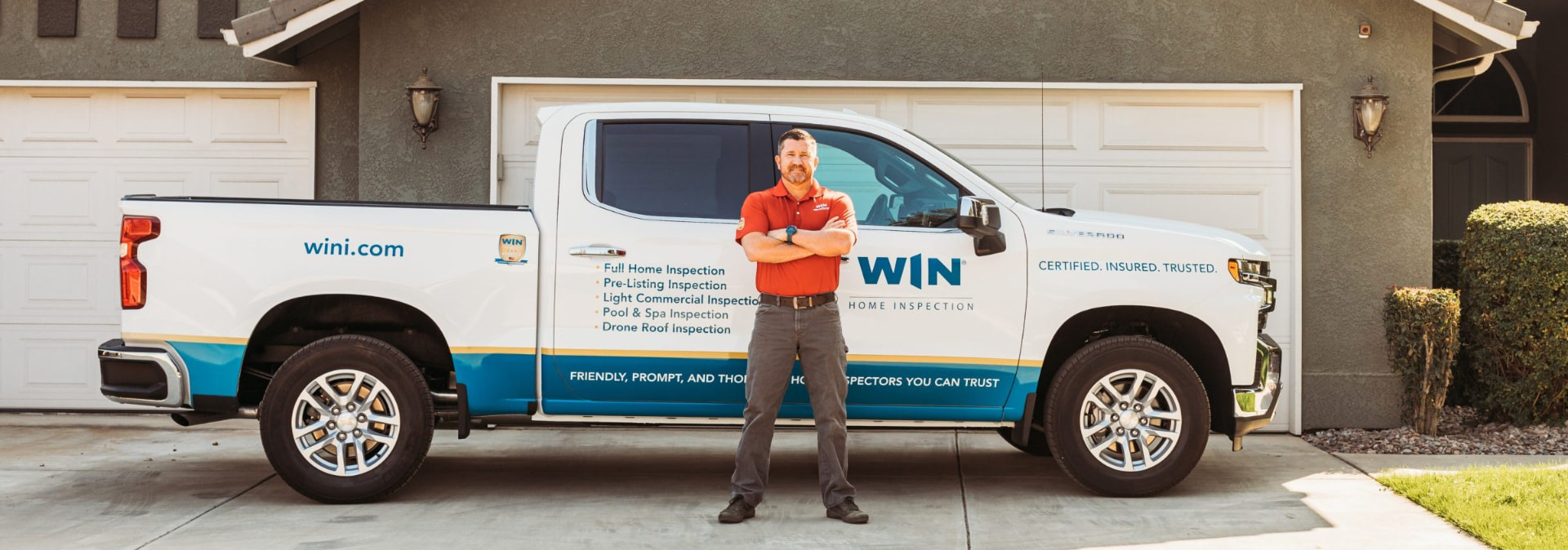
Certified. Insured. Trusted.

A Brand Kansas Homeowners Recognize On The Street

Every WIN franchise rolls out with the same recognizable identity, national trust, and proven playbook behind it.

WIN Home Inspection

Kickstart Your Home Inspection Business

If you’re serious about becoming a home inspector in Kansas but want to skip the trial-and-error of starting from scratch, explore becoming a franchise owner with WIN Home Inspection. WIN helps you navigate the entire Kansas path, guiding you far beyond the basics. Our in-house training program certifies you in 35+ essential services. This includes high-margin specialties like sewer scope inspections, radon testing, and drone roof inspections. These are highly sought-after skills in Kansas that allow you to charge more per job and significantly increase your annual earnings. This comprehensive training is included in the franchise model, so there are no outside schooling costs. We provide the end-to-end marketing, proprietary technology, and ongoing support you need to build a highly profitable, multi-stream business from day one.

In Their Own Words

Hear Directly From WIN Strategic Partners

Tim Dornford
WIN Strategic Partner | Florida
Jeff Williams
WIN Strategic Partner | Washington
Michael Strickland
WIN Strategic Partner | Georgia
Dave Fisch
WIN Strategic Partner | Arizona
Now Expanding

Ready to Own Your Territory?

See where opportunities are available today and grow with WIN’s proven systems, 35+ essential services, and dedicated support team.

Wichita
Overland Park
Kansas City
Olathe
Topeka
Lawrence
Shawnee
Lenexa
…and many more
Request Territory Info

Frequently Asked Questions

Home inspectors in Kansas earn an average of $56,500 annually, or $27 per hour. Top earners make up to $80,000 per year, while entry-level inspectors earn around $26,000 annually.

Take a training course, earn a certification, buy insurance, and set the business up with the Secretary of State. Kansas doesn't issue a license, so your training and certification are what tell a client you're qualified.

No, and that throws people. You can legally inspect homes for pay here without any state credential. Two related services are different, though, since radon testing and pest inspections both require certification.

From the state, none at all. No schooling, no exam, no experience, no insurance. The real list comes from clients and agents instead, and it's training, certification, insurance, and a registered business.

Kansas registered inspectors from 2008 until July 1, 2013, when the law reached its sunset date. Lawmakers actually voted to keep it, and it wasn't close in either chamber, but the governor vetoed the bill and nobody attempted an override. Bills in 2019 and 2022 tried to bring licensing back and went nowhere, so the state has been without a program ever since.

Not by law, though going without it makes for a rough first year. Insurers usually ask about your training when they quote you, agents ask before they refer anyone, and certifying groups won't accept you without coursework.

Start with a course that covers every major home system and report writing, built on a recognized set of standards, then get out inspecting with somebody experienced. Topics that come up a lot in Kansas include radon, hail and wind damage on roofs, foundation movement in clay soils, and the older housing around Wichita and Topeka.

It's optional, and it matters more here than it would somewhere with licensing. A credential from InterNACHI, ASHI, or the Kansas Association of Real Estate Inspectors tells a buyer you were trained and agreed to follow a set of rules, which counts for a lot when there's nothing official to look up.

General liability and errors and omissions, even though neither is required. General liability covers damage or injury on the job. Errors and omissions covers a client claiming you missed a defect, and most brokerages want proof of both before they refer you.

Yes, in nearly every case. There's no statewide business license, but forming an LLC or corporation means filing with the Kansas Secretary of State, and those entities file a report every other year to stay in good standing. Your city or county may have its own rules, so check locally too.

Not for home inspection, since there's no license to keep current. Radon certification is the exception, because KDHE requires continuing education to renew it. Your certifying group will set hours of its own as well, and InterNACHI asks for 24 a year.

Disclaimer: Requirements are set by the state regulator and are subject to change. This information is provided as a general guide and is reviewed regularly, but regulations can change at any time. WIN Home Inspection assumes no liability for any errors, omissions, or outdated details, and we recommend confirming the latest requirements directly with the relevant state agency before you apply.

Scroll to Top
BOOK A FREE
CONSULTATION
Looking for financial freedom? We can help!